
By Jenn Resendiz
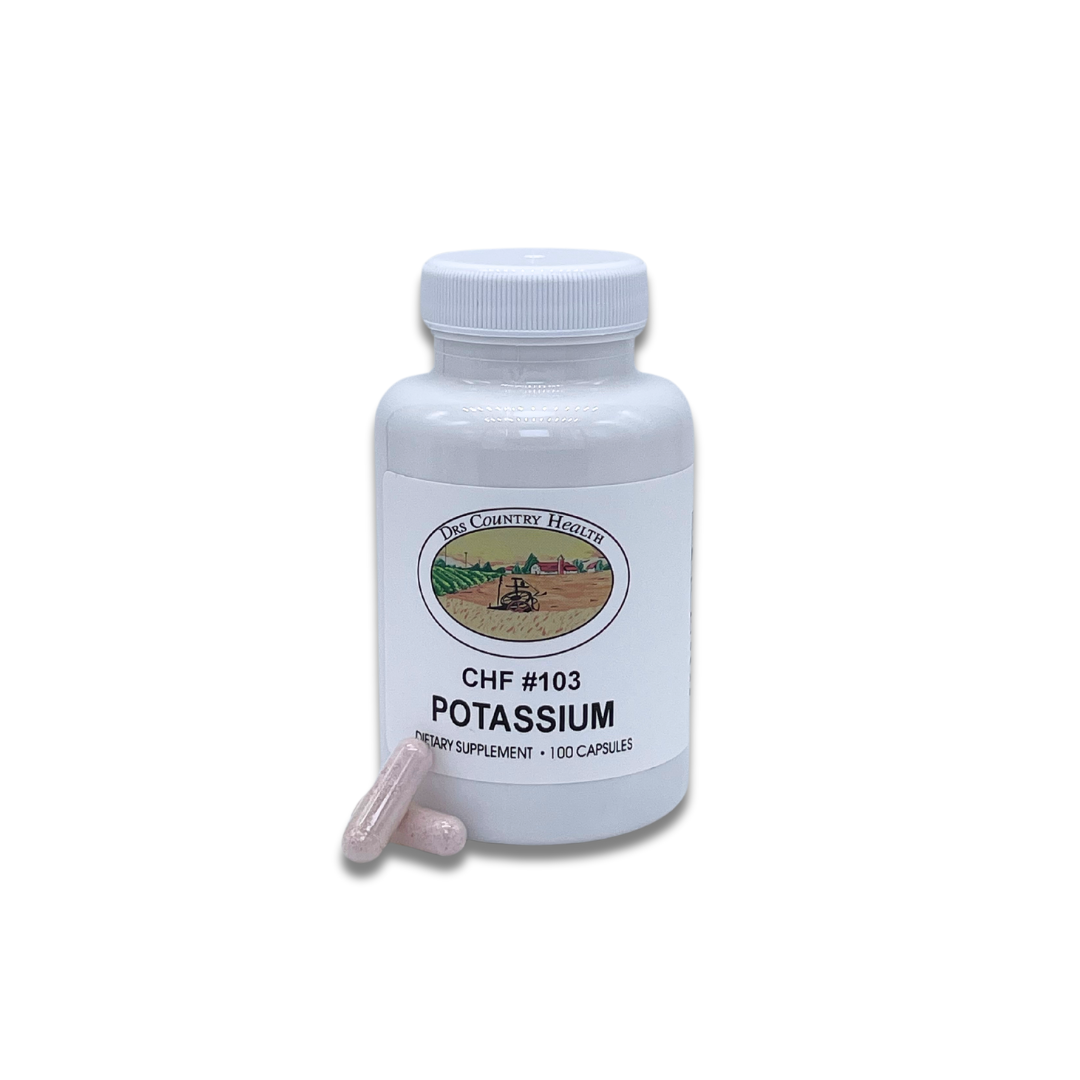
Potassium gets less attention than calcium or magnesium, yet every cell in the body depends on it. This article walks through the two ingredients in CHF #103 Potassium, Country Health’s simple daily capsule that pairs potassium citrate with a concentrated beetroot extract, and what NIH and peer-reviewed research say about each.
Full ingredient list (per capsule): Potassium (as potassium citrate) 95 mg (2% DV); Beta vulgaris (beet) root extract 10:1, equivalent to 1,000 mg whole herb, 100 mg. Other ingredients: microcrystalline cellulose, silica, magnesium stearate. Suggested use: one capsule daily or as directed by a qualified health professional. Supplied: 100 capsules.
NIH’s Office of Dietary Supplements (ODS) describes potassium as the most abundant positively charged mineral inside cells and an essential nutrient present in all body tissues. It is required for normal cell function because it maintains fluid volume inside cells and the electrical gradients across cell membranes. Potassium also works closely with sodium, the main regulator of fluid outside cells, including blood volume. MedlinePlus adds that potassium helps nerves function and muscles contract and helps keep the heartbeat regular.
ODS reports that an extensive body of research links higher potassium intakes with healthier blood pressure, in part because potassium promotes relaxation of blood vessels and helps the kidneys excrete sodium. The effect may be most pronounced in people who are sensitive to salt. Insufficient potassium, by contrast, can raise blood pressure, kidney stone risk, bone turnover, and urinary calcium loss.
Supplements use several forms of potassium, and ODS lists potassium citrate among the common ones. Citrate is also one of the natural forms of potassium found in fruits and vegetables, along with phosphate and sulfate. ODS notes that the body absorbs about 85% to 90% of dietary potassium.
Potassium citrate has a research track record of its own: ODS reports that some research suggests potassium citrate supplementation reduces high urinary calcium and the risk of kidney stone formation, citing a three-year clinical trial and a Cochrane review. Those studies used prescription-level doses well above what a dietary supplement provides, but they show why the citrate form is valued.
Readers sometimes wonder why potassium supplements list such modest amounts. ODS explains that most potassium-only supplements contain up to 99 mg, and many manufacturers keep products at or below that level because of FDA rulings on certain potassium-containing drugs above 99 mg. CHF #103 follows that convention at 95 mg, which makes it an easy, gentle addition to a potassium-rich diet.
Red beetroot (Beta vulgaris) has become one of the most studied functional foods. A review in Nutrients by Clifford and colleagues explains that beetroot is a source of dietary nitrate, which the body can use to increase nitric oxide availability, a molecule that helps blood vessels relax. The review cites human studies in which beetroot, delivered as juice or baked into bread, significantly reduced systolic and diastolic blood pressure.
Beetroot is also rich in betalain pigments, the compounds that give beets their deep red color. The same review reports that betalains display potent antioxidant and anti-inflammatory activity in laboratory and animal studies, and that human studies of beetroot supplementation have reported benefits for endothelial (blood-vessel lining) function and oxidative stress. Several studies have also linked beetroot to enhanced athletic performance. The 10:1 extract in CHF #103 delivers the equivalent of 1,000 mg of whole beetroot in each capsule.
Food is the foundation. The ODS food table lists dried apricots, cooked lentils, acorn squash, prunes, raisins, baked potatoes, kidney beans, orange juice, soybeans, bananas, milk, spinach, chicken, and yogurt among good sources. The Adequate Intake for adults is 3,400 mg per day for men and 2,600 mg per day for women, so a supplement like CHF #103 is designed to round out a produce-rich diet rather than replace it.
CHF #103 is intentionally simple: a well-absorbed citrate form of potassium plus a beetroot extract that brings nitrates and betalain antioxidants. Together they line up with what research suggests supports healthy blood pressure and circulation.
Who might consider it: adults who want a small daily potassium boost alongside fruits and vegetables, active people who like the idea of beetroot, and anyone whose provider agrees a modest potassium supplement fits their plan.
For healthy adults with normal kidney function, ODS notes that the national expert committee did not set an upper limit for potassium because the kidneys eliminate excess amounts.
No. Dietary supplements are not intended to diagnose, treat, cure, or prevent disease. Low blood potassium should be diagnosed and managed by a clinician.
Each capsule provides 95 mg of potassium as potassium citrate and 100 mg of 10:1 beetroot extract.
The label suggests one capsule daily or as directed by a qualified health professional.
Add CHF #103 Potassium to your cart or view the full product page and label.
This article is for general education only. It is not medical advice, and neither this article nor the product it discusses is meant to diagnose, treat, cure, or prevent any disease. Statements about dietary supplements have not been evaluated by the Food and Drug Administration. Talk with your doctor, pharmacist, or another qualified health professional before starting any supplement, especially if you are pregnant or breastfeeding, take prescription or over-the-counter medicines, or have a medical condition.