
By Jenn Resendiz
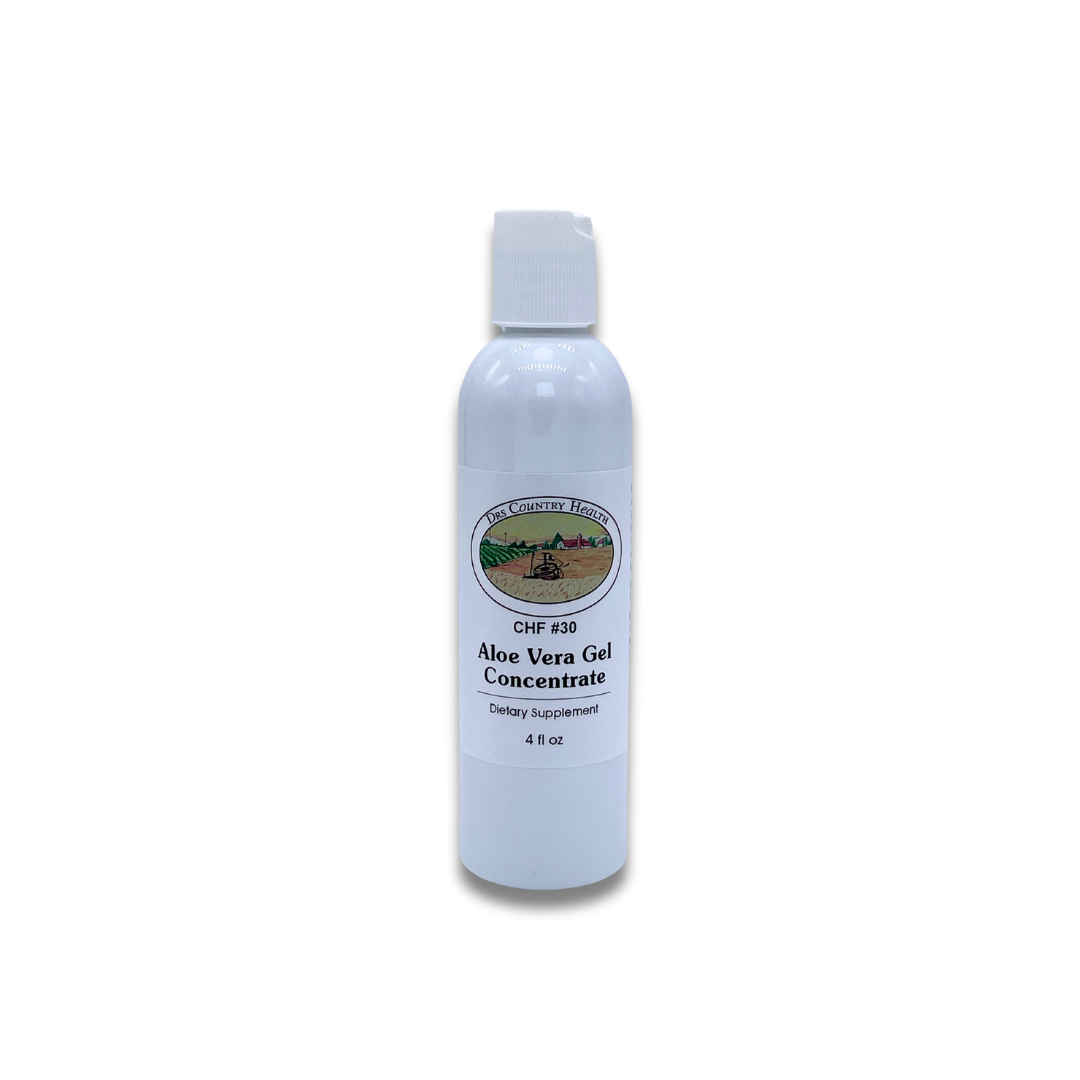
Aloe vera was used in ancient Greece, Rome, and China, and today research centers on the clear gel inside its leaves. This article looks at CHF #30 Aloe Vera Gel Concentrate, Country Health’s 4 fl oz bottle of concentrated aloe inner leaf gel, and at its best-studied polysaccharide, acemannan.
Full ingredient list: Aloe Barbadensis Leaf Juice (Gel) 10x Concentrate. The label describes pure concentrated aloe inner leaf gel containing not less than 10% polysaccharides, extracted with a nonchemical cold process. Suggested use: mix 1/2 to 1 teaspoon into a glass of water or juice twice daily or as directed; it may also be used topically to soothe skin. Supplied: 4 fluid ounces. Because CHF #30 is a single-ingredient product, the details below come from published research on aloe inner leaf gel and its natural components.
Aloe vera’s botanical name is Aloe barbadensis Miller, the plant named on the CHF #30 label. A review in the Indian Journal of Dermatology by Surjushe and colleagues explains that each leaf has three layers: a protective outer rind, a middle layer of bitter yellow latex, and an inner clear gel made of about 99% water plus glucomannans, amino acids, lipids, sterols, and vitamins. It also lists antioxidant vitamins A, C, and E, enzymes, minerals, and saponins among aloe’s many constituents.
A 2008 review in Molecules by Hamman adds that polysaccharides make up most of the gel’s dry matter and that many of aloe’s health benefits have been attributed to them.
Acemannan is the signature polysaccharide of the inner leaf. A 2019 review in Molecules by Liu and colleagues describes it as an acetylated polymannose, a chain built mostly from the sugar mannose. The review summarizes research describing acemannan’s immune-regulating, antioxidant, wound-healing, and intestinal health activities. Hamman’s review notes that the gel’s polysaccharides appear to activate macrophages, key immune cells.
Liu’s review also notes that heating can alter acemannan’s structure, which helps explain why the CHF #30 label emphasizes a cold extraction process.
Hamman’s review lists gastroprotective properties among the activities attributed to aloe gel, with proposed mechanisms including anti-inflammatory and mucus-stimulating effects. Acemannan may also feed friendly gut bacteria: Liu’s review reports that in laboratory fermentation studies, acemannan encouraged the growth of beneficial Bifidobacterium and Lactobacillus species and increased production of short-chain fatty acids such as butyrate.
Mixing the gel into juice may be a smart pairing, too. Hamman describes a randomized, double-blind crossover study in which vitamin C taken with aloe gel had about three times the overall bioavailability of vitamin C taken without it.
A 2016 meta-analysis in Nutrients by Zhang and colleagues combined five randomized controlled trials with 415 adults who had prediabetes or early, not-yet-treated high blood sugar. Compared with controls, aloe vera lowered fasting blood glucose, HbA1c, triglycerides, total cholesterol, and LDL cholesterol, and raised HDL cholesterol. The authors called for larger trials to confirm these encouraging results.
Inner leaf gel itself has been tested directly. In an 8-week double-blind, placebo-controlled pilot study, Devaraj and colleagues found that aloe inner leaf gel powders lowered fasting glucose and fructosamine in adults with prediabetes, with one also lowering total and LDL cholesterol.
The CHF #30 label notes that the gel may be applied to soothe skin, and this use has clinical research behind it. NCCIH reports that clinical research suggests topical aloe gel may speed burn healing and reduce burn-related pain. A systematic review in Burns by Maenthaisong and colleagues analyzed four studies with 371 patients and found healing time was 8.79 days shorter with aloe vera for first- to second-degree burns. Mayo Clinic agrees, and the Surjushe review explains that aloe’s glucomannan stimulates collagen-making fibroblasts while its mucopolysaccharides help bind moisture into skin.
CHF #30 delivers the inner leaf gel in concentrated form, so acemannan and the gel’s other polysaccharides, vitamins, enzymes, and sterols arrive together, and the same bottle doubles as a skin gel. NCCIH notes that research suggests short-term oral use of aloe gel, up to 42 days, is safe.
Who might consider it: adults who want a simple single-ingredient plant supplement, people interested in digestive comfort and healthy metabolic markers, and anyone whose provider agrees it fits their plan.
No. Its label lists concentrated aloe inner leaf gel, the clear center of the leaf.
The label suggests mixing 1/2 to 1 teaspoon into water or juice twice daily, or as directed. It may also be applied to skin as needed.
No. Dietary supplements are not intended to diagnose, treat, cure, or prevent disease. Talk with your clinician about any health condition.
Add CHF #30 Aloe Vera Gel Concentrate to your cart or view the full product page and label.
This article is for general education only. It is not medical advice, and neither this article nor the product it discusses is meant to diagnose, treat, cure, or prevent any disease. Statements about dietary supplements have not been evaluated by the Food and Drug Administration. Talk with your doctor, pharmacist, or another qualified health professional before starting any supplement, especially if you are pregnant or breastfeeding, take prescription or over-the-counter medicines, or have a medical condition.