
By Jenn Resendiz
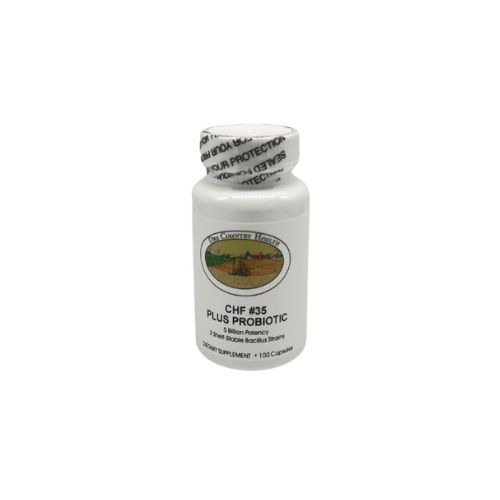
Most probiotic capsules rely on Lactobacillus and Bifidobacterium. CHF #35 Plus Probiotic 100 Capsules takes a different approach: it uses hardy, spore-forming Bacillus species and adds prebiotic fibers to feed gut bacteria. Here is what research shows about each ingredient.
Full ingredient list (per 1 capsule): proprietary blend 450 mg of Bacillus coagulans, Bacillus subtilis, and Bacillus clausii (5 billion CFU guaranteed potency per capsule), fructooligosaccharides (FOS), and inulin (from chicory root). Other ingredients: gelatin (capsule). Directions: 1 capsule between meals, 1 to 2 times daily. Store at room temperature or below.
Bacillus coagulans is a friendly bacterium that forms spores, a dormant, protective shell that helps it survive until it reaches the intestine. It has the most human research of the three species in this formula, especially for irritable bowel syndrome (IBS).
A 2023 network meta-analysis of 81 randomized trials, including 9,253 adults with IBS, ranked two B. coagulans strains, MTCC 5856 and Unique IS2, among the most effective probiotics for easing abdominal pain. MTCC 5856 also ranked high for improving stool form in people with diarrhea-predominant IBS. These results are specific to the strains studied, and they show why B. coagulans has become one of the most researched spore-forming probiotics.
Bacillus subtilis is a spore-forming bacterium with a long history in fermented foods. A 2017 review in Frontiers in Microbiology explains that Bacillus species naturally produce a large number of enzymes, antimicrobial compounds, and vitamins. The review highlights their tolerance of the harsh environment of the gastrointestinal tract and notes that they are more stable during processing and storage than many other probiotics, which makes them well suited to health-promoting formulas.
That hardiness is the idea behind the label’s statement that the blend is formulated to survive the journey from the stomach to the large intestine. It is also why CHF #35 can be stored at room temperature.
Bacillus clausii is widely used in clinical practice for acute diarrhea in children. A 2018 meta-analysis of six randomized trials involving 1,298 children found it shortened acute diarrhea by about 9 hours and shortened hospital stays by almost a day compared with control groups. It rounds out the blend with a species that has a strong track record in clinical use.
Fructooligosaccharides (FOS) and inulin are prebiotics. The NIH Office of Dietary Supplements (ODS) describes prebiotics as complex carbohydrates that gut microorganisms use as fuel. They pass undigested to the colon, where beneficial bacteria ferment them. The inulin here comes from chicory root, and FDA accepts both FOS and inulin as dietary fibers.
Pairing probiotics with prebiotics creates what is called a synbiotic: the spores deliver live bacteria, and the fibers help nourish the gut community they join.
ODS explains that probiotics work through several mechanisms. Many strains share the ability to inhibit the growth of harmful microorganisms in the gut, for example by producing antimicrobial substances and helping to normalize a disturbed microbiota. Some species also help reinforce the gut barrier and contribute enzyme activity.
CFU (colony-forming units) counts live, viable microbes. ODS notes that many probiotic supplements contain 1 to 10 billion CFU per dose and that higher counts are not necessarily more effective. At 5 billion CFU per capsule, or 10 billion at two capsules a day, CHF #35 sits comfortably in that typical range.
CHF #35 combines three spore-forming Bacillus species with two prebiotic fibers. The spores are built to survive stomach acid and storage, and the prebiotics feed beneficial bacteria in the colon. NCCIH notes that probiotics have an extensive history of apparently safe use, particularly in healthy people, and ODS says side effects in healthy people are usually minor, such as gas.
Who might enjoy it: adults looking for a shelf-stable probiotic for everyday digestive comfort, including people with IBS who are interested in Bacillus coagulans.
Probiotics are well tolerated by most people, but a few groups should check with a clinician before starting. NCCIH says the risk of harmful effects is greater in people with severe illness or weakened immune systems, and that for high-risk groups, such as premature infants or seriously ill hospital patients, risks should be carefully weighed against benefits. Please ask your clinician first if you:
If you are sensitive to fermentable fibers, you may notice a little extra gas from FOS and inulin at first.
#35 is a capsule with 5 billion CFU plus the prebiotic fibers FOS and inulin. #35C is a chewable tablet with 2 billion CFU of the same three Bacillus species, sweetened with xylitol and sorbitol.
No. The label says to store it at room temperature or below. Bacillus spores are more stable in storage than many other probiotics.
The label says 1 capsule between meals, 1 to 2 times daily.
Research suggests some specific strains, including certain Bacillus coagulans strains, can help with IBS symptoms such as abdominal pain.
Add CHF #35 Plus Probiotic to your cart or view the full product page and label.
This article is for general education only. It is not medical advice, and neither this article nor the product it discusses is meant to diagnose, treat, cure, or prevent any disease. Statements about dietary supplements have not been evaluated by the Food and Drug Administration. Talk with your doctor, pharmacist, or another qualified health professional before starting any supplement, especially if you are pregnant or breastfeeding, take prescription or over-the-counter medicines, or have a medical condition.