
By Jenn Resendiz
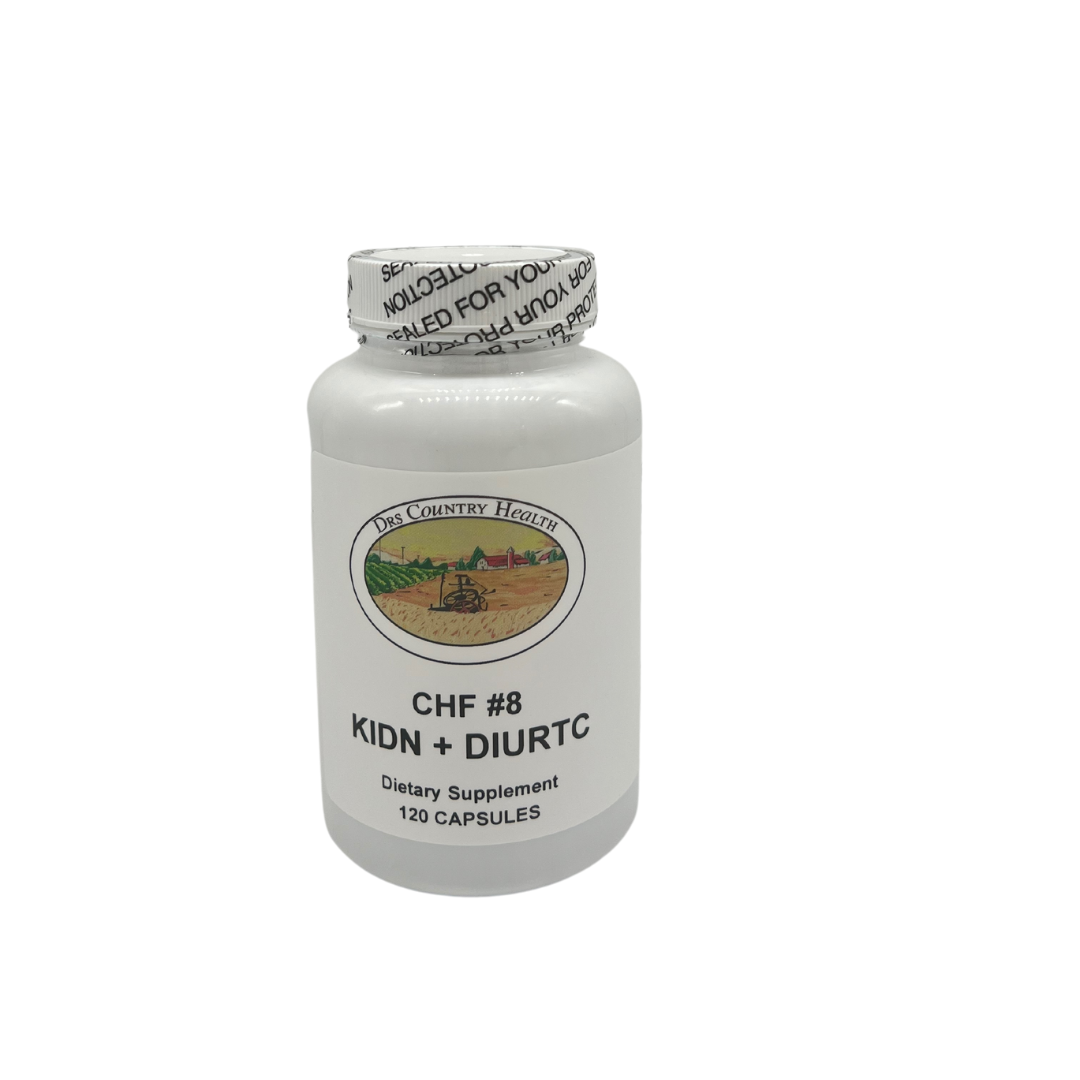
Corn silk, juniper, and parsley have been folk favorites for generations, usually to support healthy fluid balance and the urinary system. This article looks at the featured ingredients in CHF #8 Kidn+ Diurtc, Country Health’s mild herbal formula that combines corn silk, uva ursi leaf, garlic, and juniper berry with buffered vitamin C and kelp, and at what researchers and health agencies report about each one.
Full ingredient list (per 2-capsule serving): Calcium (as ascorbate) 20 mg; vitamin C (as calcium ascorbate) 164 mg; iodine (as kelp) 16 mcg; proprietary blend 532 mg of garlic bulb, corn silk, gravel (queen of the meadow) root, uva ursi leaf, celery seed, kidney substance, cleavers herb aerial parts, juniper berry, trace mineral blend, parsley leaf, and alfalfa leaf. Other ingredients: magnesium stearate, silica, gelatin (capsule). Suggested use: two capsules daily or as directed. Supplied: 120 capsules.
Corn silk is the soft, thread-like strands found under the husk of an ear of corn. A review in Molecules describes it as an important herb in traditional Chinese and Native American practice, used today in teas and supplements for urinary-related concerns. Corn silk is rich in flavonoids and other phenolic compounds, plus terpenoids, sterols, and minerals such as potassium.
The review summarizes laboratory and animal research in which corn silk extract increased urine flow and sodium excretion, findings the authors say support its traditional use as a diuretic agent. Corn silk has also shown strong antioxidant capacity, which is part of why people value it as a gentle, food-derived botanical.
Uva ursi, also called bearberry, is a low-growing evergreen shrub whose leaves have been used for urinary support for centuries. The NIH LactMed database explains that the leaves contain arbutin, which the body converts to hydroquinone, and that the herb is most often used as a urinary antiseptic.
The European Medicines Agency’s herbal committee (HMPC) concluded that, on the basis of long-standing use, bearberry leaf preparations can be used for symptoms of mild, recurrent lower urinary tract complaints, such as burning or frequent urination, in adult women once a doctor has ruled out serious conditions. That “traditional use” status means the committee found the effect plausible and the herb used safely this way for at least 30 years.
Garlic has one of the longest documented histories of any food used for health; NCCIH notes that ancient writings from Egypt, Greece, and India describe its use. According to NCCIH, garlic supplements may reduce total and LDL cholesterol to a small extent in people with high cholesterol, and limited evidence suggests they may modestly lower blood pressure in people with high blood pressure. Oral garlic has been used safely in research studies lasting as long as seven years.
Because healthy blood pressure and healthy kidneys go hand in hand, garlic is a natural partner for the other botanicals in CHF #8. In the kitchen, fresh cloves, roasted garlic, and garlic powder are easy sources.
Juniper berries are best known as the flavor in gin, but they also have a long record in folk medicine. A 2022 review in the International Journal of Molecular Sciences reports that juniper is traditionally used for bladder and kidney complaints and is rich in phenolics, terpenoids, and volatile compounds. Laboratory studies in that review found antioxidant, anti-inflammatory, and antimicrobial activity, along with renal- and gastroprotective effects.
Parsley leaf, celery seed, cleavers, alfalfa, and gravel root complete the herbal blend, each a traditional ingredient in kidney and urinary formulas. CHF #8 also includes kidney substance, a traditional glandular ingredient, and a trace mineral blend.
NIH’s Office of Dietary Supplements (ODS) explains that vitamin C is required to make collagen, an essential part of connective tissue, and that it is an important antioxidant that helps regenerate vitamin E. Calcium ascorbate is a buffered form, and each serving provides 164 mg.
Kelp supplies 16 mcg of iodine per serving. ODS notes that iodine is an essential component of thyroid hormones and that seaweed such as kelp is one of the best food sources of iodine.
CHF #8 pairs two well-known urinary botanicals, corn silk and uva ursi, with juniper, parsley, and other traditional water herbs, then adds garlic and buffered vitamin C. It is a convenient way to bring a time-honored herbal approach into a daily routine.
Who might consider it: adults who appreciate traditional herbal formulas, people who want botanical support for comfortable urinary function alongside plenty of water and a balanced diet, and anyone whose provider agrees this Country Health formula fits their plan.
No. Dietary supplements are not intended to diagnose, treat, cure, or prevent disease. Kidney and urinary conditions need care from a qualified provider.
The herbs are part of a 532 mg proprietary blend, so the label lists them in order but not individually by weight.
The label suggests two capsules daily or as directed by your health professional.
Add CHF #8 Kidn+ Diurtc to your cart or view the full product page and label.
This article is for general education only. It is not medical advice, and neither this article nor the product it discusses is meant to diagnose, treat, cure, or prevent any disease. Statements about dietary supplements have not been evaluated by the Food and Drug Administration. Talk with your doctor, pharmacist, or another qualified health professional before starting any supplement, especially if you are pregnant or breastfeeding, take prescription or over-the-counter medicines, or have a medical condition.